Start with the conditions you cannot change.
Mango, Mangifera indica, is a warm-climate fruit tree, not a dependable outdoor crop for every sunny garden. A cultivar described as compact or early does not become frost-proof. Before comparing flavour, investigate local minimum temperatures, wind exposure, drainage and the weather normally experienced during flowering.
Conditions can differ within the same region. South Florida gardens may face humid flowering weather and disease pressure; parts of inland California may have lower humidity but more troublesome cold. In Queensland and the Northern Territory, seasonal rainfall and heat patterns help shape management. These are examples of different growing contexts, not guarantees that every site within them suits mangoes.
Ask a local nursery which cultivars have actually cropped nearby. A tree growing well at a nursery is useful evidence of nursery care, but less useful than several seasons of fruiting in gardens with conditions like yours. Ask about flowering reliability, disease problems and the pruning needed to keep the tree accessible.
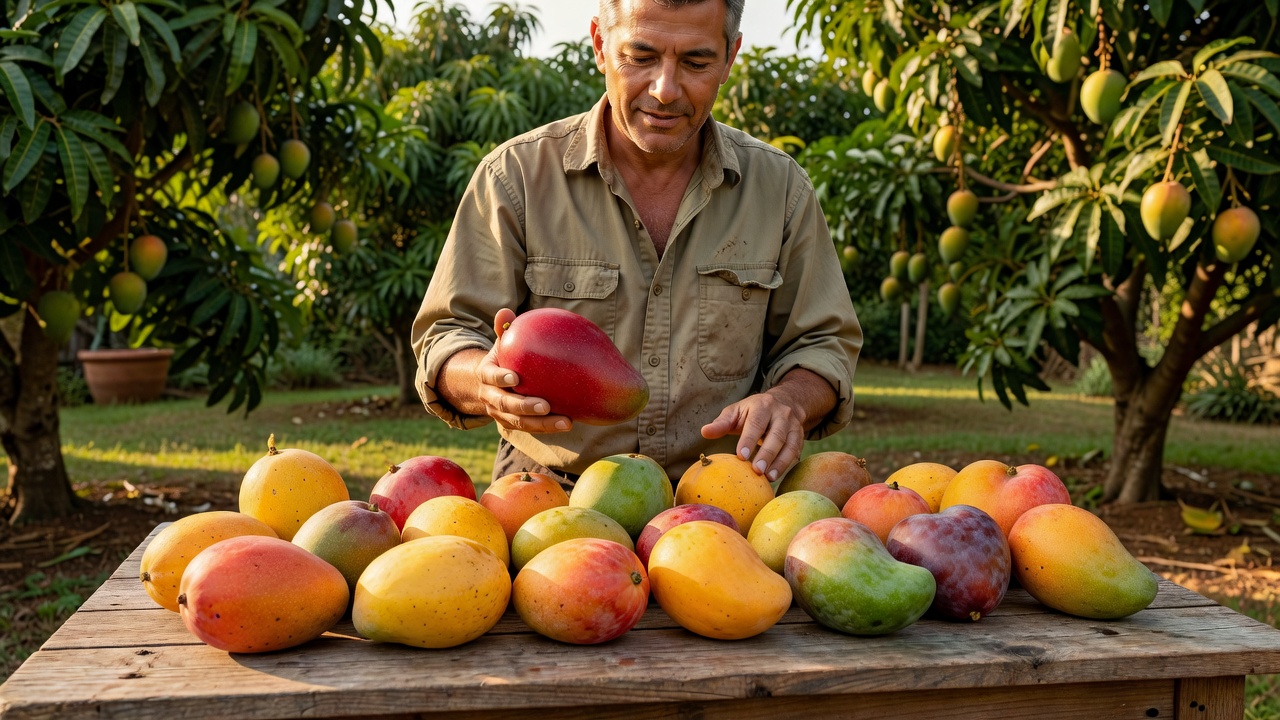
Treat variety descriptions as a starting point.
Named varieties differ in growth habit, fibre, flavour, fruiting season and response to local disease pressure. Published descriptions are useful, but labels such as “dwarf” and “disease resistant” need context. Rootstock, climate and pruning can substantially change the tree you ultimately manage.
| Cultivar | Useful character | Question to ask locally |
|---|---|---|
| ‘Pickering’ | Often selected for a relatively compact growth habit. | How does it fruit in containers here? |
| ‘Julie’ | Small-growing reputation and distinctive flavour. | How serious is anthracnose in this climate? |
| ‘Keitt’ | Often late-season; mature fruit may remain green. | Does the fruit finish before cool weather? |
| ‘Kent’ | Known for relatively low-fibre flesh. | How much canopy management is needed? |
| ‘Tommy Atkins’ | Firm fruit with good handling qualities. | Do its fibre and flavour suit your preferences? |
| ‘Kensington Pride’ | Widely grown in Australia; aromatic flesh. | How consistent is cropping at this site? |
| ‘Alphonso’ | Highly regarded flavour in suitable conditions. | Does it perform reliably outside its familiar growing region? |
Resist choosing solely by a tasting note or a photograph. A richly flavoured cultivar that flowers unreliably at your site may provide less pleasure than a locally proven one. If room allows more than one tree, different harvest seasons can spread the crop, but avoid crowding trees simply to collect more names.
Plan the canopy at harvest height.
Think about the mature tree from the ground upward. Where will its shade fall? Can you inspect flowers, remove damaged growth and pick without climbing? Keep it away from overhead services, buildings and neighbouring boundaries according to local requirements. There is no single spacing number appropriate to every cultivar and pruning system.
Container growing can help where space is limited or a young tree needs seasonal protection. Choose a stable container with unobstructed drainage holes and a durable, free-draining potting medium. Garden soil in a pot often drains poorly. Expect more frequent moisture checks, periodic root and medium assessment, and deliberate canopy control. A pot is a management system, not a permanent solution to an unsuitable climate.
In a marginal climate, moving a container under shelter may prevent cold injury, but indoor light is often inadequate for dependable fruiting. Consider whether you want an attractive experimental tree or a reliable crop. Both are reasonable aims when expectations are clear.
A healthy grafted tree buys predictability.
A grafted tree combines a selected fruiting variety with a rootstock. It usually gives a more predictable cultivar identity and earlier bearing than an unknown seedling. Seed-grown mangoes can be rewarding experiments, but seedlings do not all reproduce the parent faithfully; even polyembryonic seed does not make every seedling an assured copy.
Inspect the graft union, trunk and root ball before buying. Avoid a buried graft, badly circling roots, damaged bark or a tree that is unusually tall and weak for its container. Ask for the cultivar name in writing and any available rootstock information. Do not assume a larger nursery specimen will establish faster than a smaller, well-rooted one.
For regional background, consult public resources such as the University of Florida IFAS Extension, the Queensland Department of Agriculture and Fisheries and the University of Hawaiʻi CTAHR. Their guidance belongs to particular growing contexts; adapt it with local advice.